Osmosis AI is a purpose-built learning tool designed to help medical students quickly move from confusion to clear understanding using trusted Elsevier content, integrated directly into their study workflow. Dive into how Osmosis AI supports active learning, structured reasoning, and exam-focused preparation, without sacrificing long-term retention or critical thinking.
The power of AI, now in Osmosis
When learners get stuck, they often do the same thing: open another tab. Then another. Then another.
A quick question turns into a long search. One site says one thing. Another explains it differently. A third is full of jargon. 40 minutes later, the answer is still unclear. That kind of studying feels busy, but it doesn’t always lead to real learning.
Osmosis AI was built for exactly that moment. It offers students a way to get unstuck, but it also does something more important: it supports the kind of learning that actually lasts. Instead of pulling from the open internet, Osmosis AI is grounded in trusted Elsevier medical education content and points learners back to relevant Osmosis videos, so students can get clear explanations, check the source, and keep moving in the same learning flow.
That matters because good learning is not just about getting answers. It is about building understanding. Students learn best when they can connect ideas, see why something works, and then practice using what they know. This creates an effective learning loop: learn, apply, assess, and review. In other words, understand the idea, use it, test yourself, and come back to what you missed.
Osmosis AI is designed to support that cycle.
Built to work directly inside the Osmosis learning platform, Osmosis AI helps students go from question to clarity without sacrificing accuracy, trust, or the development of their own clinical reasoning. Let’s walk through what that really means, why general‑ purpose AI tools can fall short for medical and health professions students, and how Osmosis AI supports faster, safer, and more effective studying.

Osmosis AI is trusted more than generic AI
4 out of 5 average comparative trust rating*
Why is trust higher? Trust is driven overwhelmingly by transparent sourcing, textbook grounding, and lack of hallucinations.
*Based on a January 2026 Elsevier survey 45 Osmosis Health Leadership Initiative (OHLI) student community members. Actual results may vary.
Going from question to clarity
Going from question to clarity means understanding the why behind a concept, not just memorizing the answer.
In medical education, clarity isn’t about getting a quick one‑off response. It’s about turning confusion into structured understanding that connects basic and clinical science concepts to exam expectations and clinical practice relevance.
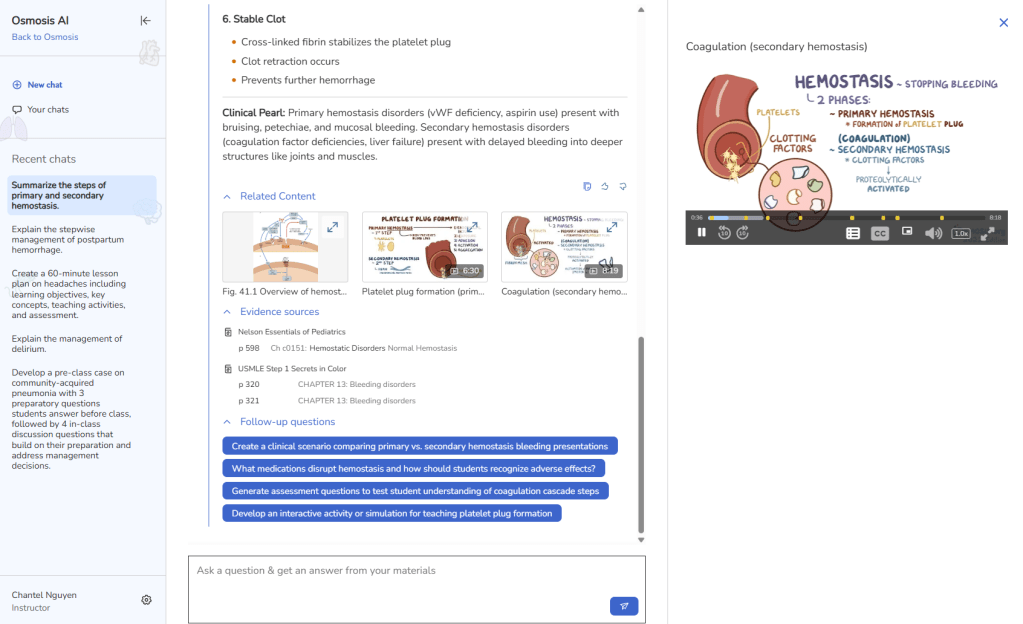
A student might start with a simple question: “Can you explain the pathophysiology of type 1 diabetes?” Instead of getting a vague or overly broad answer, they get a response built for medical learning, with citations and related videos that help make the concept visual and easier to understand. Then they can keep going. They can ask for a comparison table. They can ask for the most commonly missed facts. They can ask for flashcards or practice questions. What begins with uncertainty becomes active learning that builds connections, mastery, and confidence.
Osmosis AI supports this by providing explanations grounded in trusted Elsevier healthcare education content, connecting those explanations to visual learning resources like Osmosis videos, and suggesting guided next steps so learners don’t lose momentum. Whether they’re learning core medical concepts, understanding conditions and mechanisms, assessing knowledge with board‑style questions or flashcards, working through clinical scenarios, or asking follow‑up questions to deepen understanding, Osmosis AI keeps studying focused and on track.
Limitations of traditional search and general AI tools
Traditional search and general‑purpose AI tools can slow learners down because they introduce context switching and uncertainty.
General‑purpose AI tools can feel like they’re providing answers quickly, but they introduce a different challenge for learners: inconsistency in framing, emphasis, and relevance to what they’re studying. Even when explanations are accurate, they may not align with exam expectations or with how concepts are taught in students’ classes. That can mean extra time interpreting, verifying, or reframing information before it’s truly useful – which is particularly harmful to struggling or inefficient learners.
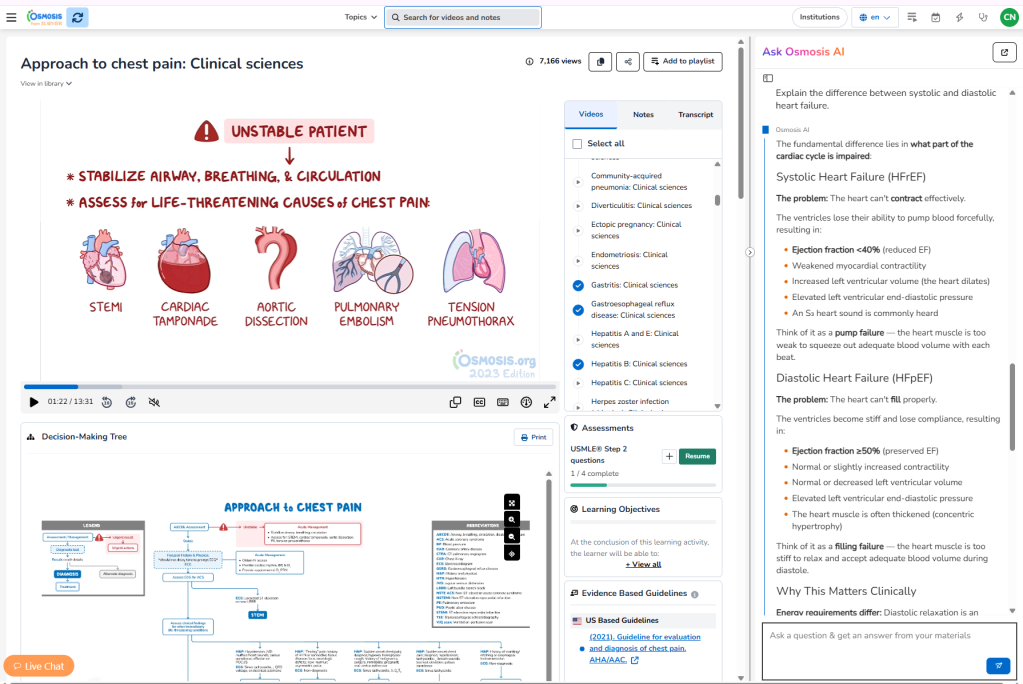
Osmosis AI stays with learners in context as students study—from videos to notes and decision-making trees. Rather than treating AI as a separate destination, a persistent chat panel remains visible alongside videos and learning content, so learners can ask questions without leaving the page. This reduces friction between getting stuck and getting clarity, keeps students focused, and allows understanding to build across a study session.
It also helps that the experience stays connected to the way many students already learn with Osmosis. Osmosis has always been strong in visual learning, and Osmosis AI builds on that. Rather than pulling students away from the platform, it can guide them back to related videos that make hard topics click. That is especially useful when a written explanation is not enough and a student needs to see the process, structure, or relationship more clearly. The product positioning is explicit on this point: video first, visual first, learning first.
There is another reason this approach matters: AI should be a coach, not a crutch. When learners depend on AI too early or too often, they can stop building the reasoning skills they actually need. The recommended approach is simple: think first, then use AI to clarify, organize, and check your understanding. That sequence helps students stay in charge of their own learning.
That is part of what makes Osmosis AI different from general-purpose AI tools. It is not designed to replace judgment. It is not meant for clinical decision support. It is not meant to replace textbooks or question banks. It is designed for learning support: clarifying hard topics, structuring information, creating study aids, and helping students practice in a more active way.
By keeping AI available but unobtrusive, Osmosis AI acts as a continuous study companion rather than a disconnected tool that lacks context.
General‑purpose AI tools for board exam preparation
General‑purpose AI tools can provide correct answers, but board exam preparation requires consistent exam‑relevant framing, clinical context, and learning‑focused structure. General‑purpose AI tools are increasingly capable and can be configured to cite sources or focus on specific domains. But because they are designed to answer many kinds of questions across many use cases, output may vary in depth, framing, or emphasis depending on how a prompt is structured.
Studying for high stakes exams requires more than just “correctness.” Learners need explanations that are consistently exam‑relevant, clinically focused, and structured in ways that support retention and application.
Osmosis AI is purpose‑built for health care education and board preparation. It operates within a controlled Elsevier content environment and grounds responses in trusted Osmosis and Elsevier resources, helping ensure explanations are consistent, traceable, and aligned with how topics are taught, tested, and applied in practice.
The importance of source citation in AI learning tools
When AI responses aren’t clearly grounded in sources, learners lose the ability to verify what they’re learning.
That can slow studying, introduce uncertainty, or lead to gaps in understanding, especially during early training. Osmosis AI provides citations so learners can trace explanations back to trusted Elsevier sources, verify details, and explore further when needed.
Osmosis is built for learning and retention
Osmosis AI is built for learning and retention because supporting health professions education requires focus and consistency, not maximum versatility.
Rather than trying to serve every possible use case, Osmosis AI is intentionally designed around how health professions students actually learn and prepare for exams. It prioritizes structured explanations, visual learning, active recall, exam readiness, and clinical application.
The goal of Osmosis AI isn’t to replace effective study practices, but to reinforce them. By encouraging students to ask follow‑up questions and assess their learning with flashcards, multiple-choice questions, and clinical cases, Osmosis AI emphasizes active learning and promotes critical thinking. This focus also supports safer use of AI in by strengthening clinical reasoning rather than encouraging passive dependence.
In practice, that means Osmosis AI supports habits that are essential for any future clinician: do not just accept an answer, check it. Do not just memorize, understand. Do not just read, practice. That is what evidence-based learning looks like.
And that is the real promise of Osmosis AI. It helps students move faster, but without skipping the parts of learning that matter most. It keeps study focused, grounded, and active. It helps learners ask better questions, make sense of difficult material, and turn confusion into understanding.
In a world full of tabs, that can make all the difference.
Osmosis AI is a purpose-built for medical education
Osmosis AI is not a standalone, general‑purpose large language model (LLM); it is a purpose‑built educational AI experience designed specifically for medical education.
Osmosis AI leverages a combination of frontier LLM technology and retrieval of Elsevier content as part of its underlying system. Osmosis AI is embedded within the Osmosis learning platform and operates within a controlled Elsevier content environment. Responses are shaped to support understanding, retention, and clinical application rather than broad or unrestricted use.
We are engaged in continuous quality improvement (CQI) with humans in the loop. Our Osmosis AI subject matter experts (SMEs) are medical educators who review Osmosis with that lens and against an educational use case Osmosis AI queries are reviewed against our evaluation criteria below using the SME, and we adjust our product based on the findings:
- Groundedness: Do responses come from retrieved content from our indexed corpus?
- Correctness: Are responses correct based on domain consensus or aligned with current standards of practice.
- Hallucinations: Are all responses grounded and correct? If not, are they fabricated content that is presented as factual?
This design focus and human-centered CQI helps ensure consistency, reliability, and alignment with how healthcare professional students are taught and assessed.

How Osmosis AI follows responsible AI principles
Osmosis AI is developed in alignment with Elsevier’s Responsible AI Principles.
These principles emphasize five core areas: real‑world impact, unfair bias prevention, explainability and transparency, human oversight, and privacy and data governance. Osmosis AI is designed as an educational support tool embedded inside Osmosis, not for clinical decision‑making. Responses are evaluated through expert review, structured quality assessments, user feedback, and ongoing monitoring.
Because Osmosis AI is a learning aid, learners should continue to verify important information against cited sources, course materials, and primary references.
Using Osmosis AI to develop clinical reasoning skills
AI can speed up learning, but how learners use Osmosis AI matters if they want to build, not replace, clinical reasoning skills.
Unstructured AI use can lead to skill erosion, including de-skilling (losing skills by offloading thinking), mis-skilling (learning errors or flawed reasoning), and never-skilling (failing to build core competencies in the first place). Automation bias, or trusting confident outputs too quickly, can make these risks worse.
Using Osmosis AI to develop clinical reasoning skills
AI can speed up learning, but how learners use Osmosis AI matters if they want to build, not replace, clinical reasoning skills.
Unstructured AI use can lead to skill erosion, including de-skilling (losing skills by offloading thinking), mis-skilling (learning errors or flawed reasoning), and never-skilling (failing to build core competencies in the first place). Automation bias, or trusting confident outputs too quickly, can make these risks worse.
The difference comes down to where AI appears in the learning sequence. Educational research often describes two models: the Cyborg model and the Centaur model. In the Cyborg model, AI is tightly integrated into the workflow and helps generate reasoning in real time. While this can mirror how AI is used in clinical practice, it is risky for early learners who are still developing independent competence.
In the Centaur model, which is recommended for early health professions learners or before baseline competence is established, users remain the primary decision‑makers. A safe Centaur workflow looks like this:
- Reason on your own (commit to your best answer or differential)
- Consult Osmosis AI to clarify understanding, organize information, or check your thinking
- Evaluate the output by deciding what you accept, reject, or modify based on your own judgment
- End with active learning, such as questions, flashcards, or clinical cases
Used this way, Osmosis AI helps students move faster without putting their reasoning on autopilot. The Centaur model protects against skill erosion and keeps AI where it belongs—as a coach that supports learning, not a crutch that replaces it.