Elsevier was delighted to attend and sponsor the ASME Annual Scholarship Meeting (ASM) 2026, held in Birmingham, UK from 30 June to 2 July.
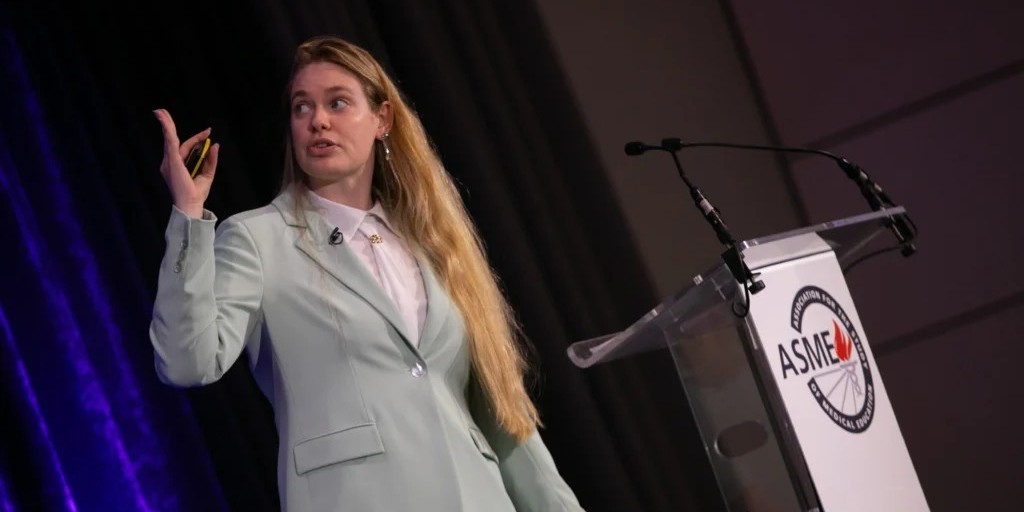
One of the highlights of Elsevier’s presence at the conference was a talk delivered by Gaia Ferrarin, Academic Success Manager at Elsevier, titled ‘From Launch to Learning: Lessons and Insights from Embedding AI-Powered Study Tools‘. Gaia shared real-world data and reflections from the first eight weeks following the launch of Elsevier’s StudyFinder AI – the AI-powered study tool within ClinicalKey Student – and offered a first look at what’s coming next with Assessment Creator.
This article brings together Gaia’s slides and the key points she discussed on the day. The following is based on Gaia’s own words from the talk, edited lightly for clarity.
From Launch to Learning: Lessons and Insights from Embedding AI-Powered Study Tools – Gaia Ferrarin, Academic Success Manager at Elsevier
The problem we set out to solve
At last year’s ASME ASM, Elsevier presented two AI capabilities we were developing for ClinicalKey Student. One was Assessment Creator, a tool for faculty to generate high-quality assessments. The other was StudyFinder AI. The question we were asking ourselves was: can we use AI to genuinely help how medical students learn? Not just give them more content, but actually help them study better, and save them time. The answer to that question was StudyFinder AI, which launched in March this year.
But to understand why we built it, you have to start with the problem. Students have access to a lot of content. The problem was that they were overwhelmed by it. They didn’t know where to start, they were jumping between resources, losing time, and increasingly turning to generic AI tools which are useful but unreliable, and completely disconnected from the trusted sources that medical education depends on.
This tool was built with students, not just for them. We ran research sessions, student forums, usability tests, faculty interviews – and we co-designed the experience around how students actually think about learning at different moments in their journey.
That’s where the depth settings come from – Introduce, Understand, Master. Students told us exactly what those should feel like.
- Introduce is orientation – buzzwords, definitions, getting your bearings on a new topic.
- Understand is "I’ve just had a lecture, and I need to go deeper" – diagrams, mechanisms, the fuller picture.
- Master is everything – the level you go to when you really need to own it.
And then the five modes – Learn, Revise, Test, Practice, and Upload. Those came from the same process: students telling us how their study needs shift depending on where they are in the week, the term, or the exam cycle.
How Students Learn with AI – Query Patterns
Gaia presented the following visual to demonstrate the range of query patterns in StudyFinder AI, from least to most common:
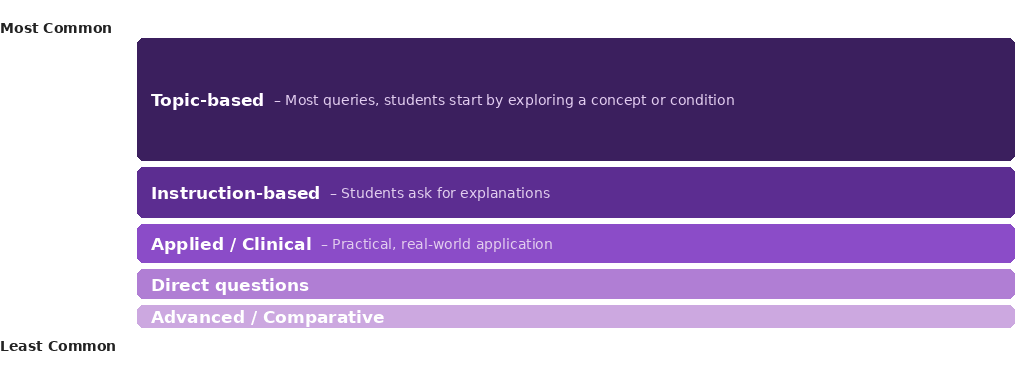
It’s worth noting that we’re still only eight weeks in. These are early patterns, not conclusions. But the signals are consistent enough to be worth talking about, and the hope is that by next year’s conference, we will bring a fuller picture.
The top bar – topic-based queries – is by far the biggest. What students are mostly typing into StudyFinder AI is just a topic. "Chest pain." "Antiphospholipid syndrome." "The renal system." Not a question. Just a concept they want to get into.
At the other end, direct questions account for fewer than one in ten interactions. Students aren’t typing "what’s the treatment for X?" They’re not trying to get to the answer quickly. They’re using StudyFinder AI to start somewhere, not to finish somewhere.
What we’re seeing is exploration first. Students begin broad and then they narrow themselves down – nobody’s telling them to. That iterative pattern – broad topic, then something more specific, then a clinical angle – isn’t shortcut behavior. It’s actually what learning looks like when it’s working.
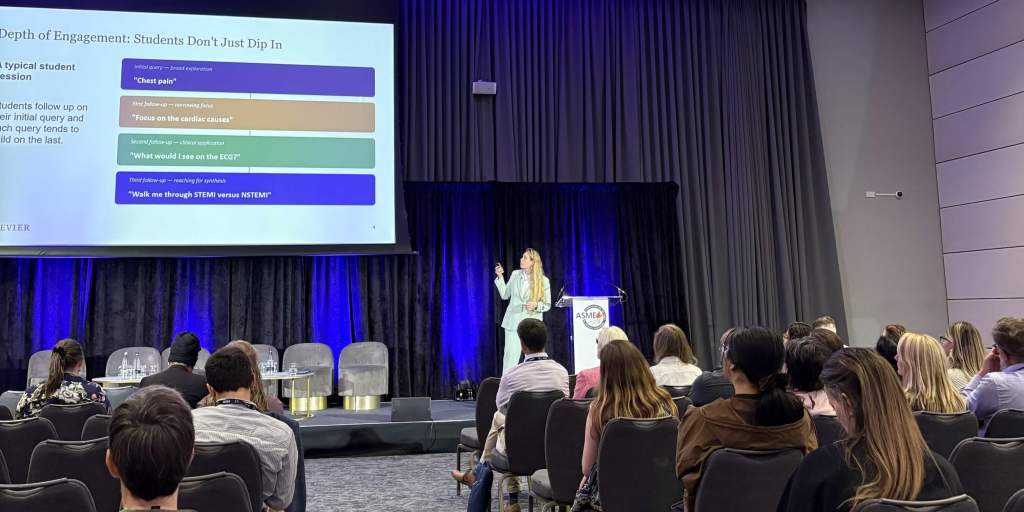
Depth of Engagement: Students Don’t Just Dip In
We know what students are querying – but what happens after that first query is just as compelling. A typical student StudyFinder AI session follows a recognizable pattern.
- Initial query
- A student opens StudyFinder AI and types "Chest pain."
- That’s broad and they’re not sure where they want to go yet. They’re just starting. And then — more often than not — they don’t stop there.
- First follow-up
- They follow up: "Focus on the cardiac causes."
- They’re narrowing.
- Second follow-up
- They follow-up again: "What would I see on the ECG?"
- Now we’re in clinical application territory.
- Third follow-up
- And again: "Walk me through STEMI versus NSTEMI."
- That’s synthesis. That’s assessment-level thinking.
All within one session. All self-directed. No one told that student to go deeper – StudyFinder AI just made it easy to keep going.
That’s what makes this finding significant for a medical education audience. Because that session doesn’t look like someone using AI to avoid thinking. It looks like someone actually learning. Starting broad, narrowing, applying, synthesizing — that’s the pattern we’d want to see in a tutorial or a case-based session. And it’s happening here, at scale, driven entirely by the students themselves.
Key Lessons for Medical Education
Lesson 1: Students are explorers, not questioners
The first lesson is perhaps the most counterintuitive – and the one I’d most want anyone designing AI tools for medical education to hear. Students are explorers, not questioners. They don’t come to StudyFinder AI with a fully formed question looking for a shortcut to the answer. They come with a topic, a concept, a thing they want to understand. If you design an AI tool around answer retrieval, you’ll miss what students actually need: something that supports curiosity-led, open-ended inquiry.
Lesson 2: Iterative learning is the natural mode
The second follows naturally from the first. Iterative learning isn’t something we’ve had to engineer in — it’s just what happens when you remove the friction. The follow-up behavior we’re seeing is students doing what students do when the environment supports it. AI, at its best, is just making it easier for them to keep going.
Lesson 3: Students self-regulate depth
When students choose to override the default and go deeper, the data shows they consistently go to the highest level. They want to master it, not just be introduced to it. That metacognitive awareness is already there.
Assessment Creator AI – Coming Soon
Everything I’ve talked about so far has been from the student side – what students are searching for, how they’re learning, how deep they’re going. But there’s an obvious question sitting underneath all of that: what does this mean for faculty? What does this mean for assessment?
That’s where Assessment Creator comes in. Launching in September, it lets faculty generate assessments – MCQs, problem-based learning cases – directly from Elsevier source material. The same trusted content students are learning from in StudyFinder AI. You pick your book, your chapter, your difficulty level, your question style. It generates, you review and edit, and assign to your students.
The thing that excites me about this, in the context of everything we’ve talked about today, is that it closes the loop. Students exploring a topic in StudyFinder AI, faculty assessing that same topic in Assessment Creator – built from the same content, on the same platform.
More to come on that in September!
Key Takeaway
When we launched StudyFinder AI, the question we were asking was whether AI could help students find better learning materials, faster. Eight weeks in, the data is telling us yes – but it’s also something more than that.
Students who engage with this tool aren’t just finding things more quickly. They’re learning differently. They’re starting broad and going deep. They’re following up, refining, building. In a digital environment, they’re doing the kinds of things we’d hope to see in a seminar room or at the bedside. AI study tools are not replacing learning. They’re extending it.
That’s the thing worth taking away from today – not the numbers, not the conversion rates, but the behavioral pattern underneath all of it. Students, when given the right environment, will seek depth. They will self-direct. They will keep going.
Our job – as educators, as product designers, as people who care about medical education – is to make sure that environment exists for as many students as possible.