
How Kangwon National University College of Medicine leverages Osmosis to support student learning from the basic medical sciences to clinical practice.
The Program
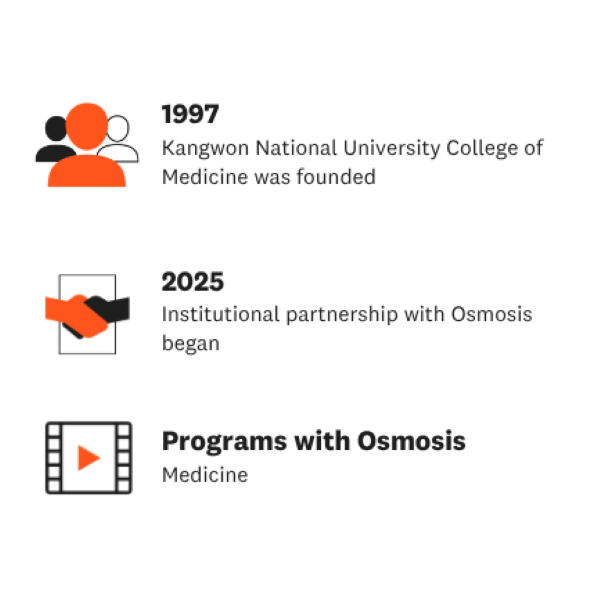
Founded in 1997, Kangwon National University College of Medicine has represented the Gangwon region, committed to developing talent to meet its local community’s healthcare needs. In 2018, it established Korea’s first Center for Medical Education Innovation to strengthen outcome-based education, and it delivers diverse clinical training through its partnership with Kangwon National University Hospital.
As student numbers rise and the educational landscape shifts, Korean medical schools increasingly need more efficient learning support. The school actively uses learner-centered methods such as flipped classroom learning, problem-based learning (PBL), and team-based learning (TBL) to build a learning environment unconstrained by time or place, and has subscribed to Osmosis since 2025 to support this approach.
“Osmosis presents complex drug mechanisms visually, enabling students to understand them intuitively. Furthermore, through assessment items that link foundational and clinical knowledge, it allows students to naturally acquire an understanding of how basic medical science is applied in real clinical settings. In this
regard, it is a highly valuable educational tool.”
Hee-Je Lee
Dean, College of Medicine Graduate School of Medicine at Kangwon National University
The Challenge
Helping students quickly grasp the full arc of clinical concepts
across fast-paced rotations, supported by reliable, high-quality
content.
Third-year students rotate through departments such as internal medicine, OB-GYN, and pediatrics in one- to two-week blocks. Within these short periods, they must absorb each department’s key diseases and apply that knowledge on the ward, creating a strong need to quickly develop a clear understanding of a broad range of clinical concepts. Textbooks have long been the central resource in medical education, but for deeper understanding after a lecture, students often turned to online sources, where finding the right content took time and the reliability of the content could be difficult to assess. Understanding pathophysiology is essential to making sense of clinical presentation and treatment, yet building that foundation across a wide range of diseases can be challenging within limited study time. Against this backdrop, students grew interested in a trustworthy tool that could naturally connect foundational and clinical sciences.
The Solution
By leveraging Osmosis’s visual learning content, the school created a learning environment that supports students in building the medical knowledge needed for clinical practice, from foundational medical sciences and pathophysiology to clinical reasoning.
1. Building a Deeper Understanding of Pathophysiology
Rather than memorizing isolated facts, students used Osmosis to understand how diseases develop and progress. While traditional textbooks often present laboratory findings, symptoms, and treatments separately, Osmosis connects disease mechanisms, clinical manifestations, diagnosis, and management into one coherent learning experience.
Students consistently reported watching Osmosis videos before reading textbooks or lecture notes, allowing them to grasp the "big picture" first and reinforce their understanding through further reading.
"When I studied disseminated intravascular coagulation (DIC), the textbook separated platelets, coagulation factors, and fibrinolysis into different sections. Osmosis connected the pathophysiology, clinical presentation, and treatment into one continuous story, making everything much easier to understand." — Lee, Third-year Medical Student
"I finally understood why thrombotic microangiopathy causes specific symptoms and why certain treatments work only after watching the Osmosis pathophysiology video." — Kim, Third-year Medical Student"
2. Pre-Rotation Preparation and Core Concept Review
As part of the third-year curriculum, students undertake clinical rotations across a range of specialties, spending one to two weeks in each discipline. To prepare for each rotation, students used concise 8–15 minute Osmosis videos to build a strong conceptual foundation before reinforcing their learning with textbooks and other course materials.
"Understanding the overall picture before entering the ward helped me understand patient cases much faster. Watching one Osmosis video before opening the textbook was actually more
efficient."— Lee, Third-year Medical Student
"Whenever I started a new rotation, I used Osmosis to get an overview of the specialty. Reading a textbook from beginning to end felt overwhelming, but Osmosis helped me quickly understand the essentials even on my phone." — Park, Third-year Medical Student
3. Bridging Foundational Sciences and Clinical Medicine
Throughout their clinical rotations, students frequently needed to revisit foundational science concepts they had learned earlier in medical school. However, after their second year, opportunities for structured review of these subjects became limited. With its extensive library of foundational science videos, Osmosis enabled students to quickly search for and refresh essential concepts whenever they encountered them in clinical practice.
"I hadn’t touched the basic sciences again since first year, so by second and third year there were concepts I just couldn’t remember and Osmosis was great for lightly jogging my memory." — Park, Third-year Medical Student
4. Developing Clinical Reasoning
The clinical setting calls for a structured thought process: starting from a patient’s symptoms, weighing differential diagnoses, selecting tests, and determining treatment. Osmosis Clinical
Sciences collection is purpose-built for learning this process step by step.
Osmosis Clinical Sciences collection shows you, start to finish, how to approach a patient when you first see them. It’s like reading a whole textbook chapter, but in a much faster and more
intuitive format. Every medical student would love this series.” — Park, Third-year Medical Student
"The AKI algorithm expands step by step, clearly showing each decision point. It helped me naturally understand the sequence of clinical decision-making." — Lee, Third-year Medical Student
The Result
Through their use of Osmosis, students experienced a meaningful shift in their learning habits. Despite demanding clinical rotation schedules, the platform became a trusted tool for self-directed learning.
Before Osmosis, students studied mainly from lecture notes and textbooks or searched online sources. Afterward, they described a habit of watching videos naturally in spare moments commuting, before bed and between tasks.
"I watched Osmosis while brushing my teeth, before going to sleep, and during my commute. Instead of watching YouTube, I was learning medicine almost without realizing it." — Park, Third-year Medical Student
"The videos are short, focused, and easy to fit into small pockets of time. That made it much easier to study consistently." — Lee, Third-year Medical Student
The visual animations and illustrations conveyed complex concepts intuitively, and that clarity carried over into long-term memory:
"I first watched the menstrual cycle video during my second year, and even a year later I still remember the illustrations and narration almost exactly." — Kim, Third-year Medical Student
Engagement also rose when professors used Osmosis directly in class. All four students interviewed agreed that even brief exposure to Osmosis during class could encourage students to
explore the platform on their own.
The volume of content can feel overwhelming at first, but searching for the one concept you need and watching a ten- minute video is enough to make a real difference. Although some
students initially had concerns about learning in English, they found that familiar medical terminology and visual animations helped support comprehension. The accompanying Osmosis high-
yield notes and transcripts provided additional ways to reinforce their learning.