
Curious about what Osmosis can do for your institution? Take a closer look inside the platform and learn how Osmosis is supporting teaching and learning around the globe.
Healthcare education is more demanding than ever. Educators need to keep students engaged, support clinical readiness, and identify struggling learners while juggling packed schedules and limited resources.
That’s where Osmosis comes in. Built on proven learning science, Osmosis brings together engaging content, clinical learning tools, performance insights, and study support in one place.
Whether you’re looking to identify high-quality learning resources, boost student engagement or gain better visibility into learner progress, Osmosis makes it easier to create effective learning experiences that fit seamlessly into your curriculum.
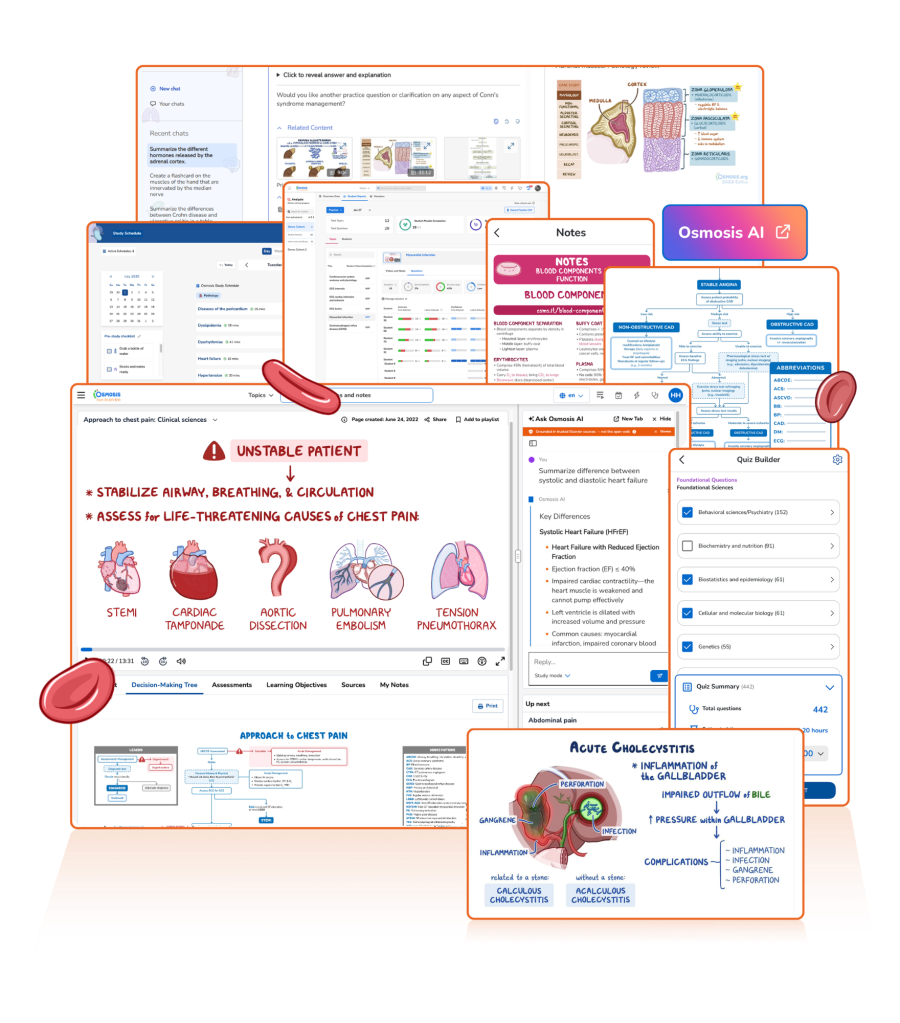
Bring complex topics to life with visual-first, multimodal content
One of the biggest challenges in healthcare education is helping students make sense of difficult concepts without overwhelming them. Osmosis addresses this through a visual-first, multimodal approach designed around how people learn best.
Every piece of content is created with learning science in mind, breaking complex topics into manageable, digestible segments that support long-term retention. Rather than relying on passive learning, Osmosis encourages active engagement through multiple content formats that accommodate diverse learning preferences.
Osmosis resources are developed and quality-reviewed by medical experts and integrate easily into existing curricula, saving educators time on sourcing materials and creating content from scratch.
Whiteboard-style videos
Osmosis videos combine clear narration, engaging illustrations, and concise explanations to make complex foundational and clinical science topics easier to understand and retain. Students can learn visually with a video and then cement their learnings through connected high-yield notes, flashcards, question banks and more for a layered learning experience. Faculty and students can also create and share curriculum-aligned playlists, making it easy to organize content around course objectives and guide learners through key topics.
Exam-style assessment questions
Osmosis includes customizable quiz builders with board-style case questions that mirror the format and rigor of key exams. Detailed answer rationales, key takeaways, and links to related learning resources reinforce understanding while helping students identify knowledge gaps and focus their study efforts where they need it most.
Flashcards
Osmosis flashcards use active recall and spaced repetition to strengthen long-term retention of high-yield concepts. Integrated with videos, notes, and other learning resources, they create a connected study experience that helps students review efficiently, track their progress, and stay focused on the concepts that matter most.
High-yield notes
Osmosis high-yield notes distill complex topics into concise, visual summaries that emphasize the concepts students need most for exams and clinical practice. Organized around key learning points and enhanced with diagrams, tables, and links to related videos and flashcards, these notes make it easier for students to review efficiently while reinforcing long-term retention.
Help students bridge the gap between classroom learning and clinical practice
Students often excel at memorizing facts but struggle when it’s time to apply that knowledge in clinical settings. Osmosis helps close that gap with the Clinical Sciences library.
The Clinical Sciences collection is built around clinically focused videos, evidence-based decision-making trees, and board-style assessments. This content guides learners through patient presentations, differential diagnoses, diagnostic workups, and management decisions, helping them understand not just what to know, but how to use it in practice.
This approach strengthens clinical reasoning by helping students recognize patterns, interpret patient presentations, and make informed decisions. It also aligns with board exam expectations, supporting preparation for rotations, shelf exams, and boards while building skills that carry into future practice.
Gain visibility into student progress before problems escalate
Understanding how students are engaging with course materials is key to supporting success early.
The Osmosis analytics dashboards give educators a clear view of how students interact with videos, flashcards, and multiple-choice questions. From a high-level overview of class engagement to detailed, individual student performance, instructors can quickly see where learners are excelling and where they may be struggling.
This visibility makes it easier to move from reactive to proactive teaching. When identifying and working with at-risk students these insights help guide more focused one-on-one check-ins. Instead of guessing where misunderstandings might happen, educators and students can identify challenging topic areas together and address gaps before moving on to new material.
Give students personalized study support—anytime, anywhere
Learning doesn’t stop when class ends, and today’s students expect study tools that fit into their busy schedules. Osmosis includes built-in learning companions designed to support students throughout their educational journey.
Osmosis AI
Osmosis AI Osmosis AI is a conversational study companion embedded in Osmosis that helps students simplify, review, and reinforce complex medical topics, and faculty streamline lesson planning. Built for medical education, Osmosis AI grounds its answers in cited Elsevier sources and surfaces relevant Osmosis videos to ensure trust and accuracy.
Built to work directly inside the Osmosis learning platform, Osmosis AI helps students go from question to clarity without sacrificing accuracy, trust or the development of their own clinical reasoning. Students can personalize their learning experience by asking clarifying questions and more alongside Osmosis videos without leaving the platform.
In Tutor Mode, Osmosis AI supports Socratic learning by guiding students through topics and clinical cases with thoughtful dialogue that encourages deeper exploration, rather than simply providing answers. Tutor Mode adapts to their level of understanding, providing instruction when they’re stuck and asking probing questions when they are ready to think more deeply. By guiding students to arrive at conclusions on their own, Tutor Mode promotes active learning, strengthens clinical reasoning and supports long-term retention.
For faculty, Osmosis AI can accelerate lesson planning by quickly generating clear, structured outlines, case-based activities, and more tailored to topic and learner level, while supporting individual teaching approaches.
Study Schedule
Creating an effective study plan can be challenging, especially in rigorous healthcare programs. The Osmosis Study Schedule tool helps students organize their learning and stay on track with personalized study plans.
Faculty can also create and share schedules aligned with course objectives, ensuring students focus on the right content at the right time while maintaining consistency across a cohort.
Mobile app
Healthcare students are constantly balancing coursework, clinical experiences, and personal responsibilities. The Osmosis mobile app makes it easy to continue learning wherever they are.
Students can seamlessly access to their study library, including videos, flashcards, notes, and quizzes, right in their pocket. Whether they are between classes, on clinical rotations, or preparing for exams, students can make the most out of any moment.
One platform designed to support better learning outcomes
Healthcare education is evolving, and educators need tools that make it easier to teach, engage students, and support clinical readiness without adding more to their workload. Osmosis brings it all together, visual-first learning content, clinical science resources, analytics, and built-in study tools in one connected platform.
If you’d like to see the full Osmosis platform in action and explore how it can support your programs specific goals, we’d love to connect.