
Today’s healthcare professionals must be able to analyze complex clinical scenarios, evaluate evidence, and make informed decisions. Developing clinical reasoning skills alongside foundational knowledge is key in medical education to help prepare the next generation of clinicians.
While answer-first learning tools can be valuable for providing quick context and helping learners find information efficiently, true mastery requires something more: the ability to think critically and arrive at conclusions independently. This is where Socratic learning plays an important role.
By encouraging learners to engage in guided questioning, reflection, and active problem-solving, Socratic learning helps build the reasoning skills students need for clinical practice. Tutor Mode in Osmosis AI is making it easier to extend this proven teaching method beyond the classroom.
What is Socratic learning?
Socratic learning is an instructional approach based on guided questioning. Rooted in the teachings of the Greek philosopher Socrates, the method uses purposeful questions to help learners examine their assumptions, identify gaps in understanding, and discover answers for themselves.
This approach encourages learners to actively participate in the learning process. Unlike traditional lecture-based instruction, where information is primarily delivered to students, Socratic learning is inquiry-driven. Instead of telling learners what to think, educators guide them through the thinking process, helping students develop the critical thinking skills necessary for long-term success.
Socratic learning in medical education
The practice of medicine requires far more than the recall of isolated facts. Clinicians must evaluate incomplete information, recognize patterns, synthesize evidence, and make sound decisions under uncertainty. Socratic learning closely mirrors the cognitive processes physicians use every day.
Building clinical reasoning
Clinical reasoning is the foundation of effective patient care. Through guided questioning, learners learn how to connect symptoms, diagnostic findings, pathophysiology, and treatment decisions. Instead of memorizing answers, students practice explaining their thought process. This allows them to identify weaknesses in their reasoning and develop a more structured approach to clinical decision-making.
Promoting active learning
Socratic learning transforms students from passive recipients of information into active participants. By engaging with questions and exploring possible solutions, learners become more invested in the educational process. This active engagement often leads to greater curiosity, more meaningful discussions, and a deeper exploration of complex concepts.
Improving long-term retention
Learners retain information more effectively when they actively engage with it. Concepts discovered through problem-solving are more likely to be remembered and applied in future clinical situations than information acquired through traditional lecture-based methods.
For medical educators, the value is clear: Socratic learning helps students develop the critical thinking and reasoning skills they will rely on throughout their careers.
How Osmosis AI Tutor Mode supports Socratic learning
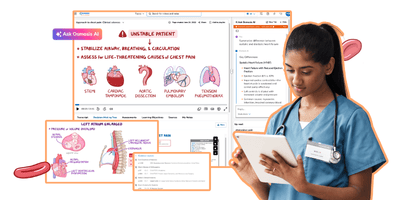
Osmosis AI Tutor Mode was designed to help bring the benefits of Socratic learning to learners whenever and wherever they study. Rather than simply delivering answers, Tutor Mode guides students through the reasoning process using a structured and adaptive approach grounded in trusted Elsevier content.
Step-by-step guidance
Tutor Mode provides Socratic, step-by-step support that helps learners work through concepts systematically. It identifies where students are struggling and offers guidance tailored to their current level of understanding. Rather than moving directly to the solution, it helps learners navigate the path to the answer themselves.
Higher-order questions
A hallmark of Socratic learning is the use of thoughtful questions that encourage deeper thinking. Tutor Mode asks probing, higher-order questions designed to promote analysis, application, and reflection. This approach helps students move beyond memorization and develop a more comprehensive understanding of the material.
Adaptive learning support that builds clinical reasoning
Every learner progresses at a different pace, and effective coaching meets students where they are. Osmosis AI Tutor Mode adapts to a learner’s level of understanding, providing instruction when they need support and encouraging more independent thinking as their confidence grows.
As students demonstrate comprehension, Tutor Mode gradually increases the complexity of its questions and prompts, helping them move from foundational knowledge to higher-order clinical reasoning. This personalized progression guides learners to uncover answers on their own rather than simply providing them. By combining adaptive support with increasingly challenging Socratic questioning, Tutor Mode promotes active learning, strengthens clinical reasoning skills, and supports long-term retention.
Supporting the next generation of clinicians
Socratic learning continues to be an effective approach for developing critical thinking and clinical reasoning skills essential to healthcare practice. Yet delivering personalized, inquiry-based instruction at scale remains a challenge for many medical educators.
Osmosis AI Tutor Mode helps bridge this gap by extending Socratic learning beyond faculty-led interactions. Through guided questioning, adaptive support, and trusted Elsevier content, it provides learners with opportunities to practice reasoning, deepen understanding, and build confidence independently.