Discover how University of the Pacific Arthur A. Dugoni School of Dentistry leveraged Osmosis to increase learner performance and faculty scholarship.
The Program
University of the Pacific (UoP) practices a humanistic model of education. This means that each individual’s dignity and limitless potential for growth is fostered. Supporting this educational mission is Dr. Sinky Zheng, who has been providing faculty development focused on pedagogy. “Most of the projects I have been working on are related to teaching and learning,” says Dr. Meixun Zheng, PhD, Educational Innovation & Assessment Director and Professor of Learning Sciences. Dr. Zheng’s work includes professional development of faculty, focused on pedagogy, which involves training the use of new technologies.
This focus on faculty development and the integration of educational technology supports UoP’s accelerated dental curriculum, allowing students to complete four academic years of instruction in three calendar years. This program structure creates a learning environment in which the curriculum is densely packed and fast-paced. Dr. Zheng’s work to develop solutions that streamline the teaching and learning process has been invaluable in the program’s success.
In part, the collaborative and open-access nature of the program is helping to elevate the dental profession as a whole. “We are open to open educational resources. We always emphasize the importance of collaboration among dental schools,” says Dr. Zheng.
The Challenge
Effectively delivering high volumes of complex content in an engaging, clinically relevant way that prepares students for real-world practice.
Modern dental accreditation emphasizes the integration and impact of oral health on systematic and overall health of individuals. Now more than ever, it’s important for dental students to have a solid fund of medical knowledge. “The students have such a large amount of information to master, especially basic science information. Some of the content could be perceived by some of the students to be dry and irrelevant to their practice in dentistry,” shares Dr. Zheng.
Obtaining traditional student success metrics like test scores or lecture attendance is relatively straightforward. However, dental educators also need deeper, more objective insights into learner engagement and attitudes.
“Student learning needs to be more broadly defined rather than only looking at the test scores. But other domains of learning could be more challenging to measure like attitude or behavioral changes,” explains Dr. Zheng.
The Challenge
Leveraging the collaborative power of Osmosis to create engaging, customizable solutions for faculty and students.
Flipped Classroom Support and Content Supplementation
“Students find Osmosis very helpful. That may have motivated faculty to check it out,” shares Dr. Zheng. “The first year and the second year focus more on the basic sciences content. [They] use Osmosis most heavily, which is consistent with the structure of our doctoral curriculum.”
While the extensive Osmosis library includes thousands of immersive videos, case-based questions, flashcards, and high-yield notes on physiology, pathology, pharmacology, clinical sciences, and more, it is designed to support locally-created curricula, not replace it.
Osmosis usage at UoP supports the flipped classroom model by helping faculty adopt this educational approach with greater ease and effectiveness. “Faculty still do lectures in class, but they might assign Osmosis videos for the students to preview before coming to class and then review after the class. The Osmosis resources are used to supplement learning, not to replace faculty’s role in the classroom. It’s voluntarily used by faculty and it’s partially student-driven.”
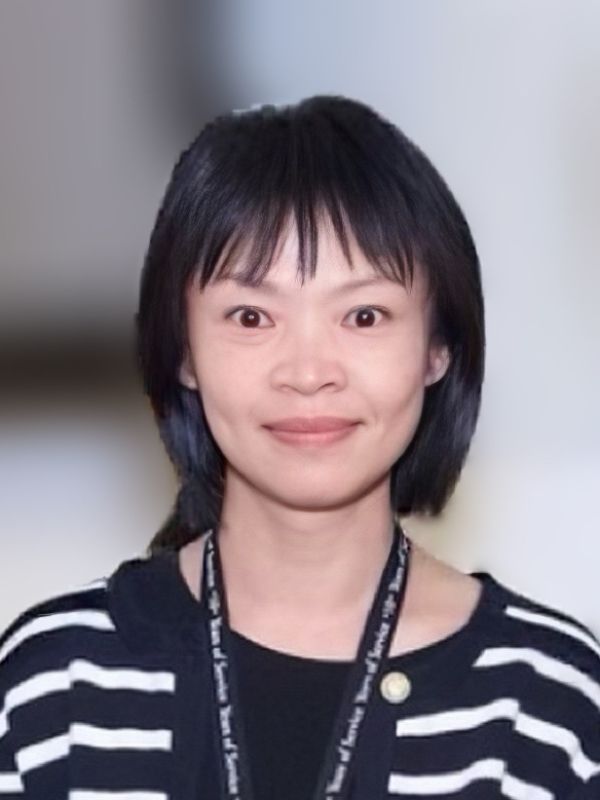
"I really appreciate the customer-focused attitude of Osmosis. They are very responsive to clients’ needs."
Dr. Meixun Zheng, PhD, Educational Innovation & Assessment Director and Professor of Learning Sciences
Flashcard Use and Collaborative Content Creation
One key feature of Osmosis is a favorite among students: flashcards. “The flashcards feature, especially the flashcard authoring tool where the student can create their own flashcards and share with their classmates, was highlighted by students as one of the most valuable features. The analytics show that students used the flashcards created by their classmates a lot. They found the collaborative feature of flashcard development to be very helpful,” reports Dr. Zheng.
Providing a platform where students can collaborate and engage in their course material with peers has had a positive impact on their overall engagement in the program, especially during those first two years of study. “Providing students with meaningful technology-enhanced learning experiences is one of the school’s strategic directions,” says Dr. Zheng. “Osmosis helps us to address some of the challenges in teaching and learning. The interactive animation format of the Osmosis videos is very engaging and the explanation by the narrators is very clear.”
“Osmosis helps us to address some of the challenges in teaching and learning. The interactive animation format of the Osmosis videos is very engaging and the explanation by the narrators is very clear.”
Co-created Custom Content
In an effort to further address content gaps, UoP sought a partnership with Osmosis that would bring their students the best learning experience possible. To help meet this objective, Osmosis provides dedicated support to guide users on how to leverage each feature in the context of their own curriculum. This ensures optimal performance that helps meet each institution’s unique needs.
Particular to UoP, opportunity arose for the development of customized dental education videos. This resulted in an UoP-Osmosis partnership that is transforming how their students care for patients.
The 36 jointly-created videos on dental specific topics give faculty “plug-and-play” visual resources that integrate seamlessly with their locally-created materials, meaning less effort for educators and a more enriching experience for their students.
The Result
Increased faculty scholarship, better student performance, and an increase in UoP’s status as a leading dental school through open-access learning materials.
“One of the immediate impacts on our faculty is their scholarship. Our academic deans are very supportive of faculty scholarship of teaching and learning. Developing videos is a type of scholarship because faculty are developing innovative learning resources for students,” explains Dr. Zheng. This translates into opportunities for faculty career advancement, partially stemming from the use of teaching innovations like Osmosis.
“Faculty can turn teaching innovation into scholarship of teaching learning such as publications. This is also one of the strategies that I’ve been using to encourage faculty to implement teaching innovation. We do have many faculty who have published papers based on their teaching innovation,” says Dr. Zheng.
In 2020, Dr. Zheng and her colleagues, Dr. Cindy Lyon, Office of Academic Affairs Professor Emeritus, and Dr. Daniel Bender, Assistant Dean of Academic Affairs, partnered with two then Doctor of Dental Surgery (DDS) students, Dr. Kenji O’Brien and Dr. Kyle Cuenin, to conduct a school-wide study with all three of their DDS classes and the two international dental studies classes. The study examined how students used Osmosis resources, such as videos, flashcards, and collaborative workspaces, and how their engagement with these tools correlated with content performance. “We found that, for first year students, the use of the Osmosis videos and the flashcards for self-assessment has a statistically significant positive correlation with their course grades and midterm and final exam performance in the basic science content areas of nutrition, biochemistry, anatomy and physiology,” reports Dr. Zheng.
“We found that, for first year students, the use of the Osmosis videos and the flashcards for self-assessment has a statistically significant positive correlation with their course grades and midterm and final exam performance in the basic science content areas of nutrition, biochemistry, anatomy and physiology.”
In addition, the Osmosis analytics showed collaboration and sharing amongst students on the platform with “The majority of the flashcards students answered were the flashcards created by the students themselves. It is wonderful to see students support each other,” says Dr. Zheng. This study helped to highlight the importance of both collaborative learning and teaching innovation, which are some of the driving forces behind the success of the Osmosis platform.
Dr. Zheng notes that the study did not fully explain usage in other learner subgroups like second year students. “There maybe other learning resources our students have been using in addition to Osmosis. Other factors that might have impacted students’ learning performance need to be further investigated. But, we have some positive preliminary outcomes that we arevery excited about,” explains Dr. Zheng.
In addition, the jointly-created dental education videos are serving UoP’s goals for an open education ecosystem where all dental education institutions can benefit and push the entire field forward. Those videos are available to all Osmosis subscribers as well as being hosted on the Osmosis YouTube channel. Dr. Zheng says, “The impact extends beyond the dental school at University of the Pacific.”
A May 2020 Journal of Dental Education paper, co-authored by Dr. Zheng, looked at the pedagogical effects of the UoP-Osmosis, co-created videos. It details promising results for the future of video production in dental education.
Embracing video production as a powerful tool in dental education
"A recent survey conducted with 257 students in the dental school demonstrated that 86% of students agreed or strongly agreed the Osmosis resources were helpful for their learning, and 92.2% of students perceived the Osmosis videos as somewhat valuable, valuable or highly valuable for learning.”1
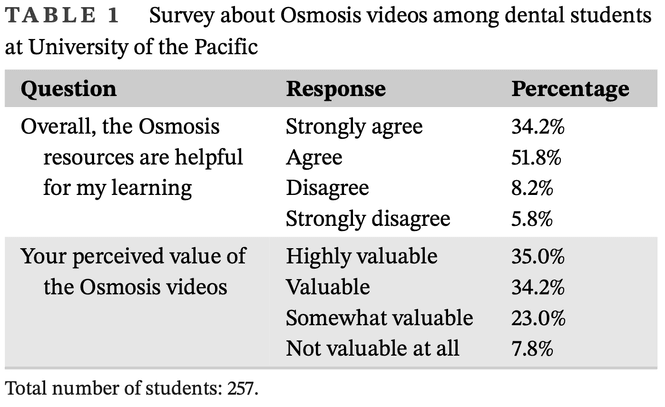
Students reported that supplementing locally-created lectures with Osmosis videos led to easier and faster learning, with the ability to speed up or slow down content to learn at their own pace.
- Morandini AC, Ramos-Junior ES, Zheng M, Desai R. Embracing video production as a powerful tool in dental education. J Dent Educ. 2020;1–2. https://doi.org/10.1002/jdd.12246
Student Usage Patterns and Interventions
Furthermore, Dr. Zheng also notes that, “Students have been using Osmosis heavily as demonstrated in the Osmosis analytics.” These metrics provide quantitative data that demonstrate learner usage patterns and their engagement with the material. This makes situations like student remediation much easier to observe and address.
Access to this individualized, granular data helps create an environment where faculty can be proactive educators and help students perform at their best, which was critical during the COVID-19 pandemic. Faculty had to “shift the focus of the learning from a one way street delivery of the content to more interactive discussions among the students in the classroom,” explains Dr. Zheng. With access to Osmosis, faculty had a tool to help them transition and provide quality learning materials to their students without the burden of development. “We hope faculty will continue to flip their classroom and implement blended learning,” shares Dr. Zheng.
Student buy-in on the Osmosis platform appears high. “Some students ask for access to Osmosis after they graduate. A student who graduated last year is now on part-time faculty in our dental school. She asked, ‘How can I access the platform? I used to have access. Do I have access now as faculty?’ I said, ‘Sure!’ Another unexpected outcome,” recalls Dr. Zheng.
This signals a valuable learning support tool in Osmosis that faculty can use to support student engagement. This promotes a passion for lifelong learning and, ultimately, better patient care.
“Faculty’s implementation of innovative resources like Osmosis has contributed to improved student learning,” says Dr. Zheng. “When faculty see the benefits of teaching in alternative ways, and pedagogical value of technology integration, they are motivated to integrate them in their teaching to support student learning.”